The Great Converter Grab: Which Anti-Theft Parts Actually Keep Thieves Off Your Exhaust
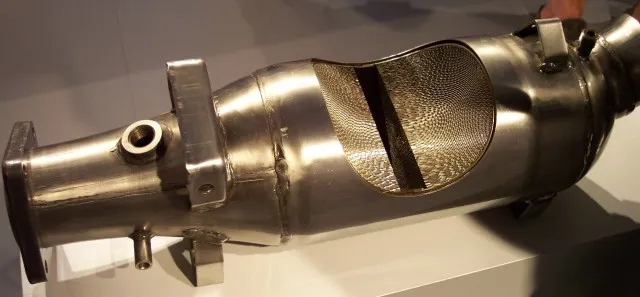
Photo: User Stahlkocher on de.wikipedia, CC BY-SA 2.0, via Wikimedia Commons
It takes about two minutes, a battery-powered cutoff saw, and no need to jack the vehicle. By morning, the owner has a $2,000 repair bill, an exhaust note that sounds like a gravel machine, and a check-engine light that will not go away. Catalytic converter theft went from niche crime to nationwide epidemic in a few short years, and the aftermarket has answered with a wall of anti-theft gear—some of it genuinely effective, some of it strictly decorative. Here is what the data says and what is actually worth bolting on.
The Numbers Behind the Sawzall
Insurance industry figures tell the story in one ugly line. Claims data tracked by the National Insurance Crime Bureau climbed from roughly 1,300 catalytic converter theft claims in 2018 to about 14,400 in 2020, then blew past 52,000 in 2021 before settling at painfully elevated levels. The driver is chemistry, not mystery. Converters contain platinum, palladium, and rhodium—metals that spiked hard during the pandemic-era supply crunch, with rhodium briefly trading above $20,000 an ounce. To the thief, your converter is worth $50 to $250 at a scrap counter. To you, replacing it runs $1,500 to $4,000 installed, and more in states with stricter emissions rules. That asymmetric math is the entire crime wave in one paragraph.
What Thieves Are Shopping For
Two vehicle families dominate the victim list. First, hybrids—especially the Toyota Prius—because their converters carry a heavier load of precious metals to compensate for cooler exhaust temperatures. A clean, low-mileage hybrid converter is the jackpot. Second, high-clearance trucks and SUVs like the Ford F-250 and F-350 Super Duty, Toyota Tundra, Tacoma, and 4Runner, where a thief slides underneath without a jack and gets to work. Fleet vehicles and delivery vans get hammered for the same reason: easy access and predictable parking patterns.
Geography matters too. Major metros in California, Texas, Minnesota, and Georgia have posted some of the highest totals, and state scrap-yard reporting laws tend to push theft activity across borders rather than eliminate it. If you park outside in a metro area, assume you are on the list.
The Deterrent Field, Ranked
Shields and Cages: The Workhorses
Bolt-on steel or aluminum shields and cable cages run roughly $150 to $400 installed, and they are the best dollar-for-dollar deterrent on the market. Toyota sells factory skid shields for high-theft models, and aftermarket options like the Miller Cat plate or CatClamp cage cover nearly everything else. The logic is simple: thieves are opportunists with a saw and a schedule. A shield turns a 90-second cut into a noisy, grinding, multi-minute fight in a place they do not want to be. Most move on to the next driveway.
Alarms and Tilt Sensors
Vibration and tilt sensors mounted near the converter, usually $100 to $300, work well for fleet lots, apartment complexes, and repeat victims. The catch is that an alarm only matters if someone responds. In a detached garage situation, they are thin. As a layer on top of a shield, they are reasonable.
Etching and Paint Programs
Many police departments and sheriff's offices offer free VIN etching events, stamping your vehicle identification number into the converter case and marking it with high-visibility paint. Etching does not stop the cut, but it makes the part radioactive to legitimate scrap dealers and helps prosecutors build cases. It is cheap, worth doing, and nowhere near sufficient on its own.
Parking and Routine
Unglamorous but effective: park nose-in against walls, use garages when you have them, and avoid long-term street parking in poorly lit areas. Access is the number one factor in every theft pattern we have seen.
What Counts as Security Theater
Etching alone. A dashboard camera that films a blurry silhouette. Aftermarket stickers promising alarms that do not exist. Ultra-thin strap kits that a bolt cutter dismisses in one squeeze. None of these adds meaningful friction, and friction is the entire game.
If It Is Already Gone: The Replacement Maze
Replacement is its own adventure. Most states accept EPA-compliant aftermarket converters, but California—and New York, which follows CARB rules for most passenger vehicles—require CARB-certified units with an executive order (EO) number on the label. Budget accordingly: a CARB-compliant converter installed can easily clear $2,500, while the same job on a federal-emissions vehicle often lands between $1,000 and $1,800. One more warning: skip the deep-discount converters floating around online marketplaces. A surprising share of them are stolen inventory, and buying one keeps the cycle going.
The winning setup is layered and boring: a physical shield, etching from your local PD, and parking habits that deny easy access. Boring, in this case, is about $300 well spent against a four-figure surprise.